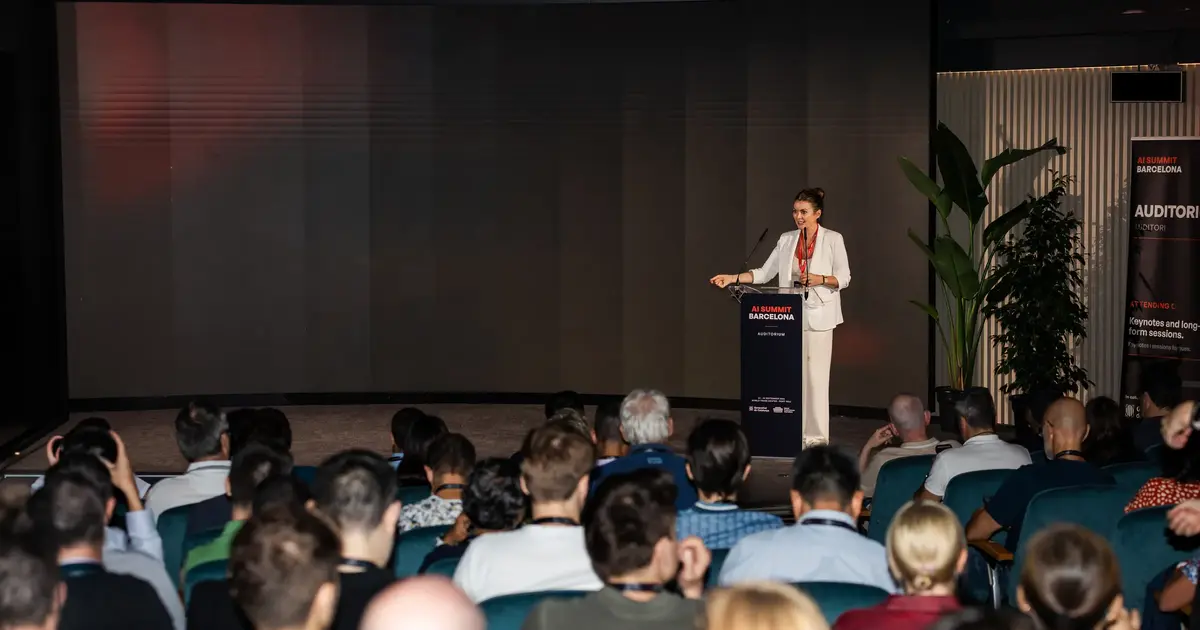
Explore the AI summit landscape in Europe: event formats, dated market context and the role of Barcelona. Use this dossier for ecosystem background and the European conference comparison for a shortlist.
What changed on 3 October 2026: the reader journey now reflects the completed Barcelona edition, with recordings and a 2027 waitlist. Market figures retain the dates of their original cited reports.
What is AI Summit Europe
There is no single body that owns the name "AI Summit Europe." It is best understood as a search category and a shorthand for the cluster of large artificial-intelligence events that take place across the continent: from policy-led gatherings such as the AI Action Summit in Paris, to commercial mega-shows such as VivaTech and Web Summit, to dedicated AI conferences such as AI Summit Barcelona. When people type "ai summit europe," "ai conference europe" or "european ai conference" into a search box or an AI assistant, they are almost always asking the same practical question: which AI event in Europe is worth my time, and when is it?
This dossier answers that in three layers. First, the market: the scale, money and talent that make Europe a genuine third pole of global AI, in figures you can cite. Second, the events: a comparative table of the main AI summits in Europe, with real dates, cities and audience sizes. Third, the recommendation: why, for most international visitors, the heart of European AI now beats in Barcelona, and how to plan a trip around it.
An AI summit typically combines keynotes, technical tracks, an expo floor, hackathons and structured networking. The best of them compress a whole ecosystem (research labs, startups, investors and enterprise buyers) into two or three days. That compression is precisely why they matter: in a field moving as fast as AI, being in the room is still the fastest way to understand it.
Why an AI summit is different from a general tech conference
It is worth being precise about the distinction, because the word "summit" is used loosely. A general tech festival such as VivaTech or Web Summit spans the whole technology industry, with AI as one very large theme among many: fintech, mobility, climate, consumer hardware. A government policy summit such as the AI Action Summit convenes heads of state and regulators around governance and safety, with limited room for founders and engineers. A dedicated AI summit, by contrast, is built end-to-end around artificial intelligence: every stage, workshop and exhibitor is there for the same reason.
For someone trying to read a market, that focus changes the value of the trip. At a dedicated AI event you are not filtering AI signal out of general tech noise: the whole room is the signal. That is the lens through which to read everything that follows in this dossier, and the reason a two-day, AI-only format such as AI Summit Barcelona’s 2026 programme punches above its headcount.
A short history of AI events in Europe
Europe has hosted serious AI gatherings for decades, but the centre of gravity has shifted from the lab to the boardroom and the policy table. A brief timeline:
The throughline is clear: AI events in Europe have grown from small scientific meetings into one of the continent's most strategic stages, where regulation (the EU AI Act), capital and product collide.
The European AI market, in sourced figures
To understand why "AI Summit Europe" is even a meaningful phrase, start with the market behind it. Europe is not a follower in AI: it is a distinct pole with its own scale, capital base and rulebook. The figures below are drawn from recognised reports and dated to their source.
Investment and funding
European AI startups raised about $11 billion in 2024, led by companies such as Mistral AI, Helsing, Wayve, Poolside and DeepL.
AI and deep tech captured 33% of all European venture funding in 2024, out of roughly $45 billion raised by European startups that year.
European deep-tech startups raised $94 billion over the past decade, against $123 billion in Asia and $300 billion in the US.
The European Commission's InvestAI initiative aims to mobilise €200 billion for AI across the EU, including €20 billion earmarked for large-scale AI "gigafactories," announced at the AI Action Summit in February 2025.
European Commission, InvestAI / AI Continent Action Plan, 2025
France alone committed roughly €109 billion in AI-related investment announced around the Paris summit.
Companies, talent and adoption
Europe now counts roughly 35,000 early-stage tech companies, 3,400 late-stage companies and 358 firms valued above $1 billion, up from just 72 such companies in 2015.
88% of organisations report using AI in at least one business function and 71% regularly use generative AI, though only about a third have scaled it across the enterprise.
23% of organisations are already scaling an agentic-AI system, a sign that AI agents are moving from demo to deployment.
Europe recorded a net loss of 492 technical workers to the US in 2023, down sharply from a net loss of 1,585 in 2022.
Research base and sovereign capacity
Europe's strength has always been upstream, in research and open science. The continent produced the academic groundwork for much of modern machine learning, and that lineage still shows in its open-source output: Hugging Face, the de-facto hub for open AI models, and Mistral AI, a French lab shipping competitive open-weight models, are both European. This open, distributed character is why European AI cannot be read off a single funding number: much of its value sits in talent, research and shared infrastructure rather than in a handful of mega-rounds.
The newest piece of the picture is sovereign compute. The European Commission's plan funds up to five AI "gigafactories" (large-scale facilities each combining the power of more than 100,000 advanced AI processors) intended to be operational around 2027–2028, offering compute-as-a-service with data residency and AI Act compliance built in (European Commission, AI Continent Action Plan, 2025). The strategic logic is plain: a continent that wants to set the rules for AI also wants the means to train it on its own soil. For executives, this turns "European AI" from a policy abstraction into a procurement question, and there is no faster way to understand it than to spend two days among the people building it.
The picture that emerges is a market with deep technical roots and fast-rising enterprise demand, where the gap with the US is one of capital and scale rather than ideas. That context helps explain why company, research and adoption questions meet on the European event circuit. For the company side of this story, see our guide to the top AI startups in Europe and our overview of the European AI ecosystem.
Europe vs the US and China
The honest framing is that the United States leads on private capital and frontier model output, China leads on deployment scale, and Europe leads on regulation, applied adoption and a distinctive trust-first model. The numbers make the contrast concrete:
| Metric (year) | United States | China | Europe / UK |
|---|---|---|---|
| Private AI investment (2024) | $109.1B | $9.3B | UK $4.5B; EU startups ~$11B in AI |
| Notable AI models produced (2024) | 40 | 15 | 3 |
| Decade of deep-tech funding | $300B | $123B (Asia) | $94B |
| Defining strength | Capital & frontier models | Deployment scale | Regulation, applied AI, trust |
Sources: Stanford HAI, AI Index 2025 (investment, notable models); Atomico, State of European Tech 2024 (deep-tech funding, EU AI startups).
Europe's edge is structural and worth taking seriously. The EU AI Act is the world's first comprehensive AI law: it entered into force on 1 August 2024, its bans on "unacceptable-risk" practices and its AI-literacy duties applied from 2 February 2025, obligations for general-purpose AI (GPAI) models applied from 2 August 2025, and most high-risk-system rules apply from 2 August 2026 (European Commission, AI Act, 2024–2026). Whatever you build, if it touches European users it must meet European rules, which is why understanding the European market is no longer optional for any serious AI company, wherever it is based.
That regulatory reality is one reason a global audience travels to European AI summits: they are the fastest way to absorb how AI governance, enterprise adoption and capital actually intersect on the continent.
There is a second, quieter reason Europe matters out of proportion to its funding share: adoption. McKinsey's 2025 survey found that 88% of organisations already use AI in at least one function and 71% use generative AI regularly, yet only about a third have scaled it, and 23% are now scaling agentic systems (McKinsey, The State of AI, 2025). In other words, the centre of gravity in AI is shifting from "who builds the best model" to "who deploys it best at scale", a contest in which Europe's industrial base, regulated sectors and enterprise AI demand make it a serious player. The companies winning that race are exactly the ones you meet at a dedicated AI summit.
The main AI summits and tech events in Europe
"AI Summit Europe" resolves, in practice, to a handful of major events. They differ in nature: some are policy summits, some are giant general-tech festivals where AI dominates, and some are dedicated AI conferences. The table below compares the principal ones, with real dates and cities for the 2026 cycle.
| Event | City | 2026 dates | Scale | Focus |
|---|---|---|---|---|
| AI Summit Barcelona | Barcelona | 22–23 Sep 2026, past edition | Final attendance not cited | Dedicated AI: founders, builders, investors, enterprise |
| VivaTech | Paris | 17–20 Jun | 180,000+ | General tech & startups, AI-led |
| Web Summit | Lisbon | 9–12 Nov | 70,000+ | General tech, AI headline theme |
| GITEX Europe | Berlin | 30 Jun–1 Jul | Large expo | Enterprise tech & AI exhibition |
| London Tech Week | London | 8–12 Jun | City-wide | Tech & investment, strong AI track |
| Slush | Helsinki | 18–19 Nov | ~13,000 | Founder & investor matchmaking |
| AI Action Summit (series) | Paris (2025) → New Delhi (2026) | Feb (biennial-style) | 100+ nations | Government & AI policy |
Sources: official event sites and listings for 2026 (VivaTech, Web Summit, GITEX Europe, London Tech Week, Slush); AI Action Summit: French Presidency / India AI Impact Summit 2026. Figures are organiser projections and may vary by edition.
A little more on the principal events:
How to read this table: if you want policy and geopolitics, the AI Action Summit series is the stage; if you want sheer scale and consumer tech, VivaTech and Web Summit are unmatched; if you want a two-day, AI-only signal on the European market (the founders building it, the investors funding it and the enterprises buying it, in one place), that is the niche AI Summit Barcelona occupies. For deeper rankings, see our guides to the best AI conferences in Europe and the biggest AI events in Europe.
Why Barcelona is at the heart of European AI
Picture Europe from the outside: from San Francisco, from Singapore, from Bangalore. You are not looking at one city; you are looking at a continent of strong, scattered hubs: Paris with its foundation-model labs, London with its capital and enterprise depth, Berlin with its startup density, Amsterdam with its data and connectivity. The practical question for a visitor is not "which hub is best" but "where can I stand to see all of them at once?"
The answer increasingly is Barcelona, on the Mediterranean. It is geographically central, exceptionally well connected, and now one of Europe's strongest tech ecosystems in its own right:
And then there is logistics, which is decided less by prestige than by flight maps. Barcelona–El Prat is one of Europe's most connected gateways, with direct long-haul links from North America and beyond and dense connections to every major European capital. For a founder or executive flying in from the US or Asia, "I'm going to Europe for AI" can comfortably mean "I'm going to Barcelona", and from there, the whole continent is in the room.
Set Barcelona against the wider European map and the logic of "crossroads, not capital" becomes clear:
| European AI hub | Known for |
|---|---|
| Barcelona | Top-5 EU startup hub, leader in Southern Europe; deep tech, healthtech, applied AI; Mediterranean access and an international talent magnet |
| Paris | Foundation-model labs (incl. Mistral AI) and a large research base; major public AI investment |
| London | Capital markets, enterprise AI and the densest investor network in Europe |
| Berlin | High startup density and applied AI across industry |
| Amsterdam | Enterprise, data and a highly connected ecosystem |
| Helsinki / Nordics | Deep engineering talent and a strong founder culture |
That is the real argument for Barcelona: not that it has overtaken Paris or London, but that it sits at the crossroads of all of them, on the Mediterranean, easy to reach and easy to leave. Read more in our dossier on the European AI ecosystem and our ranking of the top AI startups in Europe by city.
AI Summit Barcelona at a glance
The 2026 edition took place on 22–23 September at WTC Barcelona. The event pages provide its programme context; future attendance and learning from recordings are separate journeys.
| Your question | Useful destination |
|---|---|
| What was on the programme? | 2026 schedule and tracks |
| Who participated in the programme? | 2026 speakers |
| Which recordings can I access? | Digital Pass catalogue and conditions |
| How do I follow the next edition? | 2027 waitlist |
Learning after the 2026 edition
Start with a question you want to understand. Review the available recordings on the Digital Pass page and choose subjects that match that question. A viewing session can help prepare a discussion with colleagues, identify an assumption or point to further research.
The Enterprise AI guide helps frame adoption questions. The model comparison supplies criteria for evaluating tools. Neither requires you to attend an event or submit an enquiry.
Planning a future European AI visit
Use the conference guide to understand formats and the guide by role to choose an objective. Check dates, venue, access and programme details with the relevant organiser before making plans.
For AI Summit Barcelona, the 2027 waitlist is the route for future updates. This guide does not announce a confirmed 2027 date, venue or ticket price.
Continue learning through Summit recordings
Review the available catalogue and access conditions for the subjects you want to investigate.
Sources
Frequently asked questions
What does AI Summit Europe mean?
The phrase can refer to different AI gatherings in Europe. This guide describes the wider landscape; it does not treat every use of the phrase as a reference to AI Summit Barcelona.
Which European AI summit should I choose?
Choose by your learning goal, role, programme focus and the audience you need. Use the European conference comparison and the guide by role, then verify the edition with the organiser.
When was AI Summit Barcelona 2026?
The 2026 edition took place on 22–23 September at WTC Barcelona. Available recordings and access conditions are described on the Digital Pass page.
How can I follow the next Barcelona edition?
The tickets page provides a 2027 waitlist. Check published announcements for future dates, programme and attendance conditions.
Are the market statistics current forecasts?
The market figures are dated to the reports cited in the article. They are context for the European ecosystem, not new forecasts or evidence of an event’s final attendance.
Written by
- Guillaume RostandCEO, AI Summit Barcelona
Related reading
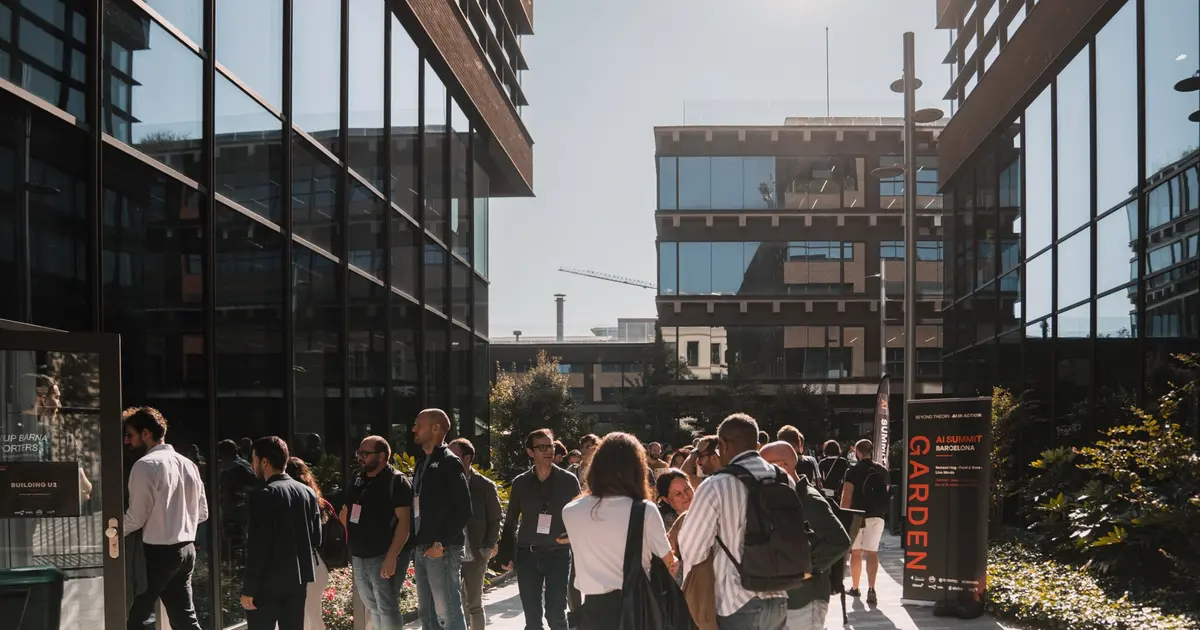
AI Conferences: The Complete Guide
Understand the main event formats and what to consider when choosing between them. Start with the purpose of your visit, then explore the more focused comparisons and planning resources.
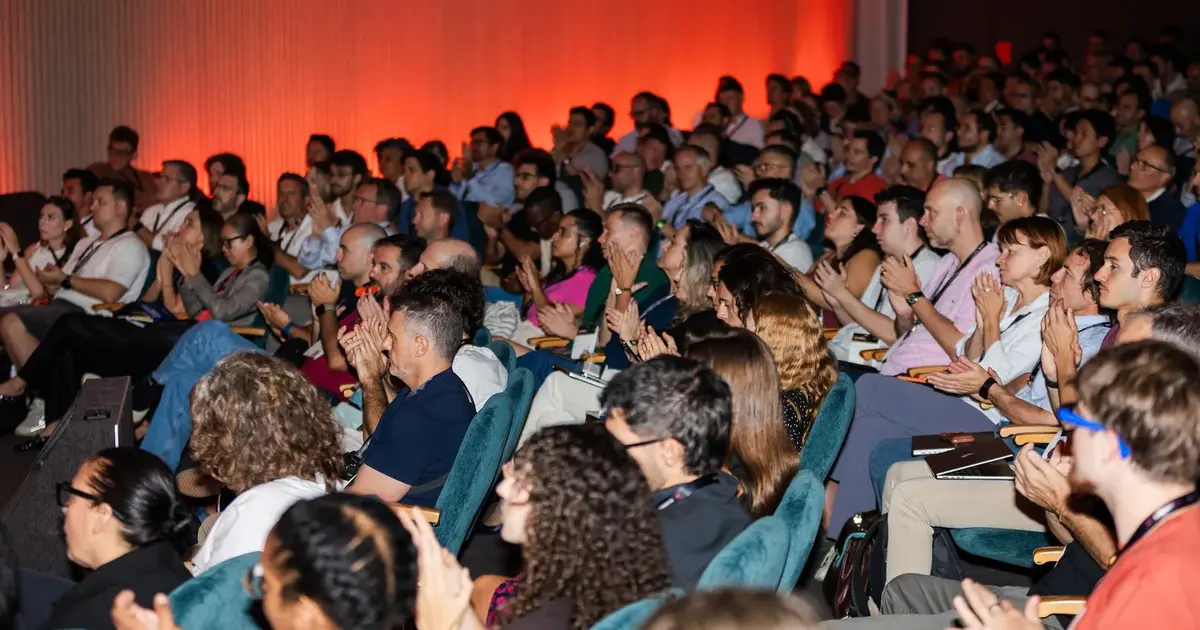
Best AI Conferences in Europe
Compare events by focus, audience and the experience you are looking for. Review the selection criteria and check current details with the organiser before making plans.

Barcelona's AI Ecosystem: A Guide for Corporate Visitors
Understand research, applied innovation and technology community perspectives in Barcelona. Build a visit around your business question and confirm every host and access arrangement.